
Borrow against Solana assets with Teller and Rome
Teller’s proof-of-concept demo on Rome’s Hadrian devnet lets borrowers submit loan requests against supported Solana assets and lenders fund them, with Phantom handling wallet connection and signing. The demo uses test assets.
Teller’s new proof-of-concept demo on Rome’s Hadrian devnet brings Solana assets into Teller’s EVM lending contracts, with Phantom handling wallet connection and signing.
Borrowers can submit a loan request against supported collateral, and lenders can review the terms and fund it. The demo shows SOL-backed USDC borrowing through a Solana wallet, using Teller’s lending infrastructure on Rome.
Open the Hadrian demo with Phantom
What Rome makes possible
Rome runs an Ethereum Virtual Machine inside the Solana runtime. That makes it possible for EVM lending contracts to work with Solana assets while a Solana wallet authorizes the actions.
For Teller, this opens a path to bringing its lending model to Solana wallet users. The demo connects Phantom directly as a Solana wallet, and the app handles the account setup and token wrapping needed to interact with Teller’s contracts.
Phantom remains the signing wallet throughout the flow. A separate EVM private key is not required.
Submit a loan request
The demo uses a loan-request book. Borrowers select supported collateral and an amount, review the proposed borrowing terms, and submit a request.
For example, SOL can back a request to borrow USDC. The form shows the borrowing amount, collateral, loan-to-value ratio, APR, term and fees. Advanced settings allow the proposed terms to be adjusted within the market’s limits.
Once submitted, the request appears in the book for lenders to review. A request becomes a loan when a lender accepts and funds it; unfunded requests expire.
Fund a request
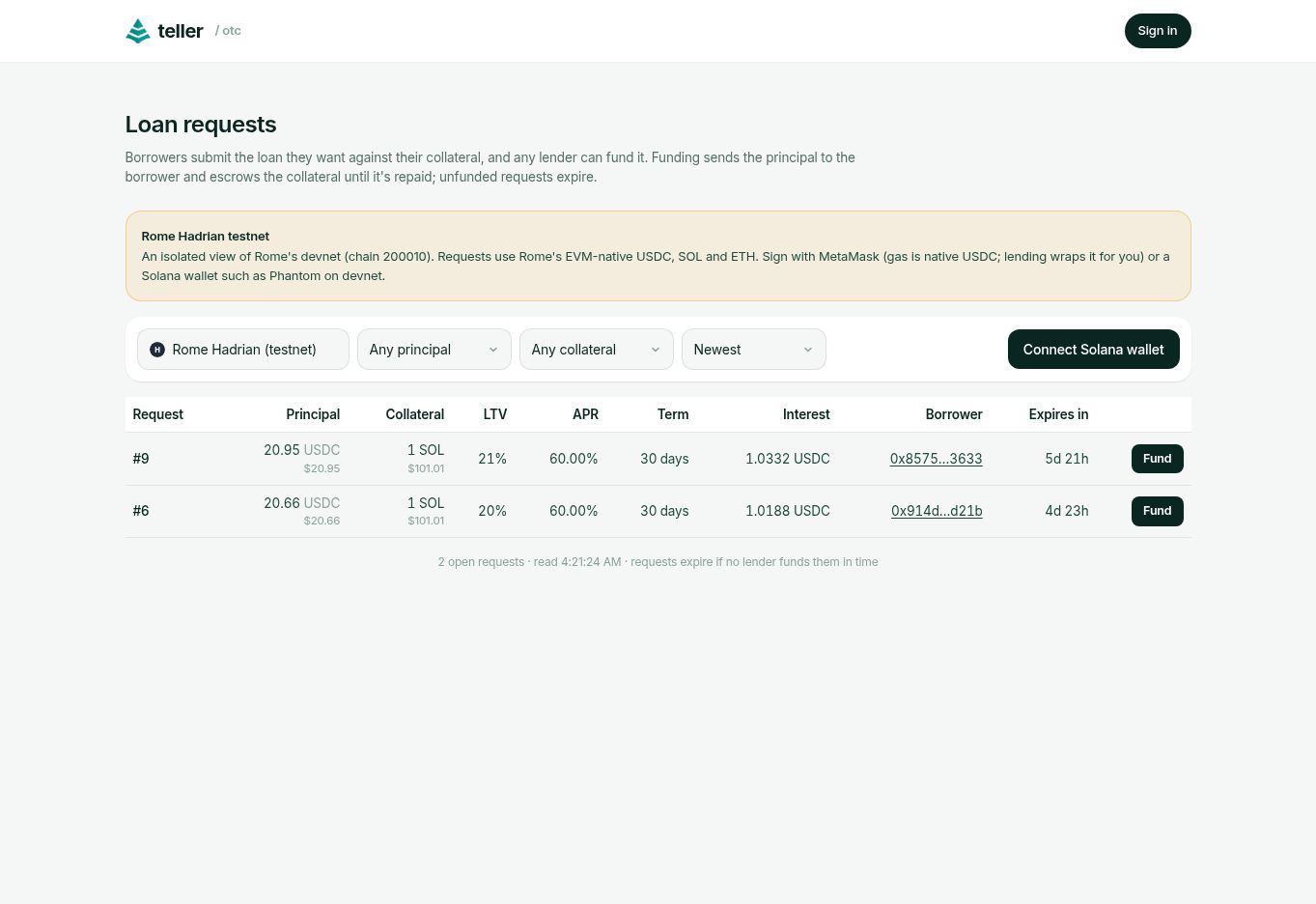
Lenders can compare the open requests by principal, collateral, LTV, APR, term and interest, then select Fund to review a request.
Funding sends the principal to the borrower’s Rome account and moves the collateral into escrow. The borrower can then use Withdraw to wallet to bring the proceeds back into Phantom.
The distinction matters: submitting a request proposes a loan. A lender’s funding transaction starts it.
How Phantom is used
- Open the dedicated demo link. The URL selects Hadrian devnet and the direct Phantom connection.
- Use Phantom on Solana devnet. Testing requires devnet assets, with some devnet SOL for transaction fees and account setup. USDC is also used for the funding flow and gas when a call uses Rome’s relay.
- Select Connect Solana wallet. Approve the connection in Phantom.
- Request or fund a loan in Teller. Review the terms in the app, then review and approve the transaction or message prompts in Phantom. An action can require several approvals.
- Withdraw available proceeds to Phantom. The app unwraps the assets held by the Rome account and transfers them back to the connected Solana wallet.
Teller displays a Rome address associated with the connected Solana wallet. This is the account that interacts with the EVM contracts, while Phantom controls the signatures.
Behind the interface, supported assets are wrapped into a form Teller’s EVM contracts can use. The app coordinates these steps and shows progress as the wallet approvals are completed.
What the proof of concept demonstrates
The demo connects three parts of an onchain loan: a borrower’s Solana assets, Teller’s EVM lending contracts and a lender willing to fund the request.
It demonstrates a route to borrowing against supported Solana assets without selling them, while keeping wallet authorization in Phantom. Teller loans have a defined repayment term, with no price-triggered margin calls during that term. Collateral remains subject to the loan’s default terms if repayment is missed.
This is a Hadrian devnet proof of concept using test assets. The balances and terms shown belong to the demo.
Try the Teller × Rome demo with Phantom
Rome: @RomeProtocol
See if you pre-qualify for a no-collateral loan
Answer a few quick questions to explore loan options from Lending Partners.
Check if you pre-qualify →