
New Teller Collateral: EGG, MarsCoin, and Basecat
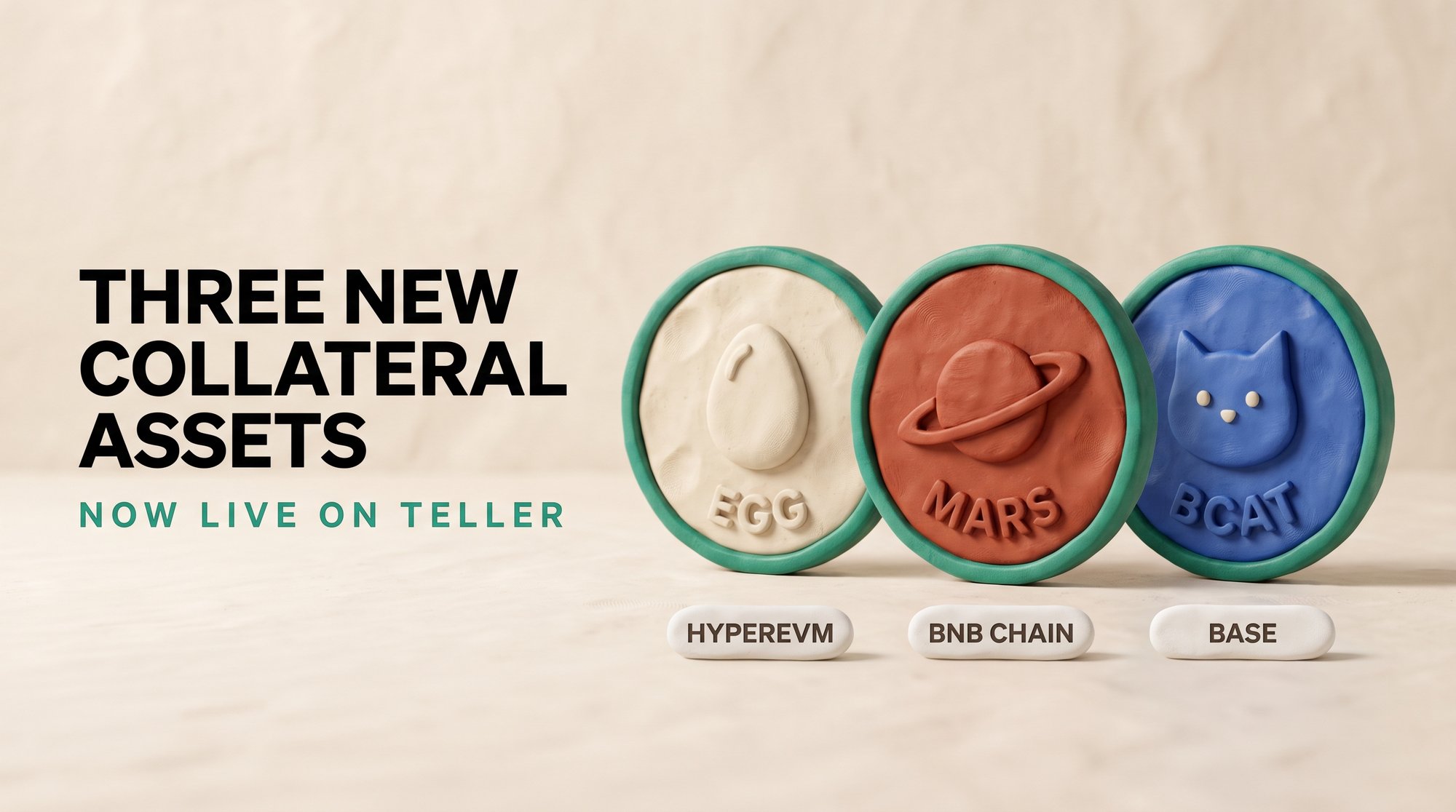
Teller now accepts EGG (HyperEVM), MarsCoin (BNB Chain), and Basecat (Base) as collateral, which means anyone can launch an isolated lending pool or post a lending offer against them today. Because Teller loans are time-based rather than price-based, a borrower posting one of these volatile assets faces no health factor and no liquidation price — only a due date.
Teller now supports three more tokens as collateral: EGG on HyperEVM, MarsCoin on BNB Chain, and Basecat on Base. All three are live in the token catalogue, which means lending pools and lending offers can be opened against them starting today.
That brings the protocol past 100 supported ERC-20 collateral assets across nine chains, backed by more than $80M in cumulative loan volume since 2021.
Why these three
Every collateral listing on Teller comes down to one question: is there enough on-chain depth behind the token for an oracle to price it honestly, and for a lender to recover value if a loan expires unpaid. Each of these three cleared that bar on its own market activity, not on a partnership deal.
EGG (HyperEVM)
Contract: 0xb75d5ee14708e7efbea939311090061d72265608
EGG trades on Hyperswap with roughly $180K of pool liquidity turning over more than $360K in a single day. That is a turnover ratio above 2x, which is unusual and worth reading carefully: it means real trading, but in a shallow book. The token is about a month old.
HyperEVM has been one of the fastest-growing venues on Teller. Pricing EGG against the same liquidity that HyperEVM traders already use keeps the oracle honest and the loan terms local.
MarsCoin (BNB Chain)
Contract: 0xfe189e97832da1573e4e4ff034f4ffc3a15c7777
MarsCoin is the deepest of the three. Around $3.8M of liquidity sits across three PancakeSwap pools, and those pools cleared north of $40M in 24-hour volume. The token is roughly 40 days old and has been one of the more actively traded assets on BNB Chain in that window.
Depth like this supports higher loan-to-value terms than a thinner asset would, and it gives a Dutch auction somewhere real to land if a loan ever defaults.
Basecat (Base)
Contract: 0xb2000000000000000000004c27f6523082f41d01
Basecat runs about $2M of liquidity spread across Uniswap and Aerodrome pools on Base, doing close to $9M in daily volume at roughly three weeks old.
One warning worth repeating: more than one contract on Base answers to the name Basecat, including one with a large but almost entirely inactive pool. The address above is the one Teller prices and accepts. Check it before signing anything.
What this actually unlocks
Supporting a token as collateral on Teller is not the same as switching on a money market. There is no shared risk pool and no protocol-set interest rate. What opens up is permission:
Launch a pool. Anyone can deploy an isolated lending pool that takes one of these tokens as collateral and lends a principal of their choosing. The launcher sets the loan-to-value, the APR range, and the maximum loan duration. Those terms are fixed at deploy time, and so is the TWAP oracle route the pool prices collateral through.
Post a lending offer. A single wallet can publish standing terms against any of the three without escrowing capital up front. The money stays in the lender’s wallet until a borrower draws on it.
Borrow, loop, or short. Once a pool exists, holders can post the token and draw stables against it without selling, lever a long in one transaction, or post a stable and short the token instead.
The part that matters for volatile collateral
Teller loans are time-based, not price-based. Price movement never causes a default. Only expiration does.
For a three-week-old memecoin, that distinction is the entire product. On a conventional money market, a 40% intraday wick against a leveraged position closes it, and the borrower eats the loss regardless of where price settles an hour later. All three of these tokens have moved double digits in a single day in the past week. On Teller there is no health factor, no liquidation price, and no margin call. A borrower who posts EGG and draws USDC keeps that position until the term ends, whatever price does in between.
The trade-off is real and runs the other way: if principal plus interest is not repaid by the due date, the collateral is forfeited and goes to a 24-hour Dutch auction to make the lender whole. There is no partial liquidation and no grace period. Fixed term means fixed term. (For how that differs from a pooled, price-triggered design, see Teller vs Aave.)
Risk, plainly
These are new, thin, extremely volatile assets. All three are under two months old. Nothing about a Teller listing is an endorsement of any of them.
Lenders considering a pool against these tokens should size to the auction, not the market cap. The question is not what the collateral is worth today, it is what a Dutch auction could actually clear in 24 hours if a large loan defaults during a drawdown. On a $180K pool, that number is a lot smaller than the screen suggests.
Borrowers should treat the term date as the only date that matters. Set the reminder.
Get started
Pools and offers against EGG, MarsCoin, and Basecat can be opened now at teller.org. New to how any of this works? Start with how crypto-backed loans work.
Market figures cited are on-chain readings from September 5, 2026 and will have moved. Nothing here is financial advice.
Frequently asked questions
EGG on HyperEVM (chain ID 999, contract 0xb75d5ee14708e7efbea939311090061d72265608), MarsCoin on BNB Chain (chain ID 56, contract 0xfe189e97832da1573e4e4ff034f4ffc3a15c7777), and Basecat on Base (chain ID 8453, contract 0xb2000000000000000000004c27f6523082f41d01). All three are live in the Teller token catalogue, so lending pools and lending offers can be opened against them.
Collateral support is the first step: it lets anyone deploy an isolated lending pool or post a lending offer against these tokens. Borrowing becomes available as soon as a lender opens a pool or an offer for the asset you hold, and the terms — loan-to-value, APR, and duration — are set by whoever opens it, not by the protocol.
No. Teller loans are time-based, not price-based. There is no health factor, no liquidation price, and no margin call, so price movement alone never closes a position. The trade-off is that if principal plus interest is not repaid by the due date, the collateral is forfeited and sold in a 24-hour Dutch auction to repay the lender. There is no partial liquidation and no grace period.
0xb2000000000000000000004c27f6523082f41d01 on Base. A second contract on Base carries the same name with a large but nearly inactive pool. Teller prices and accepts the address above; verify it before signing anything.
The test is on-chain depth: whether there is enough real liquidity for a Uniswap V3 TWAP oracle to price the asset honestly, and enough for a Dutch auction to recover value if a loan expires unpaid. All three of these tokens cleared that bar on their own trading activity rather than through a partnership.
See if you pre-qualify for a no-collateral loan
Answer a few quick questions to explore loan options from Lending Partners.
Check if you pre-qualify →