Swaps are live in Teller, routed through ShapeShift
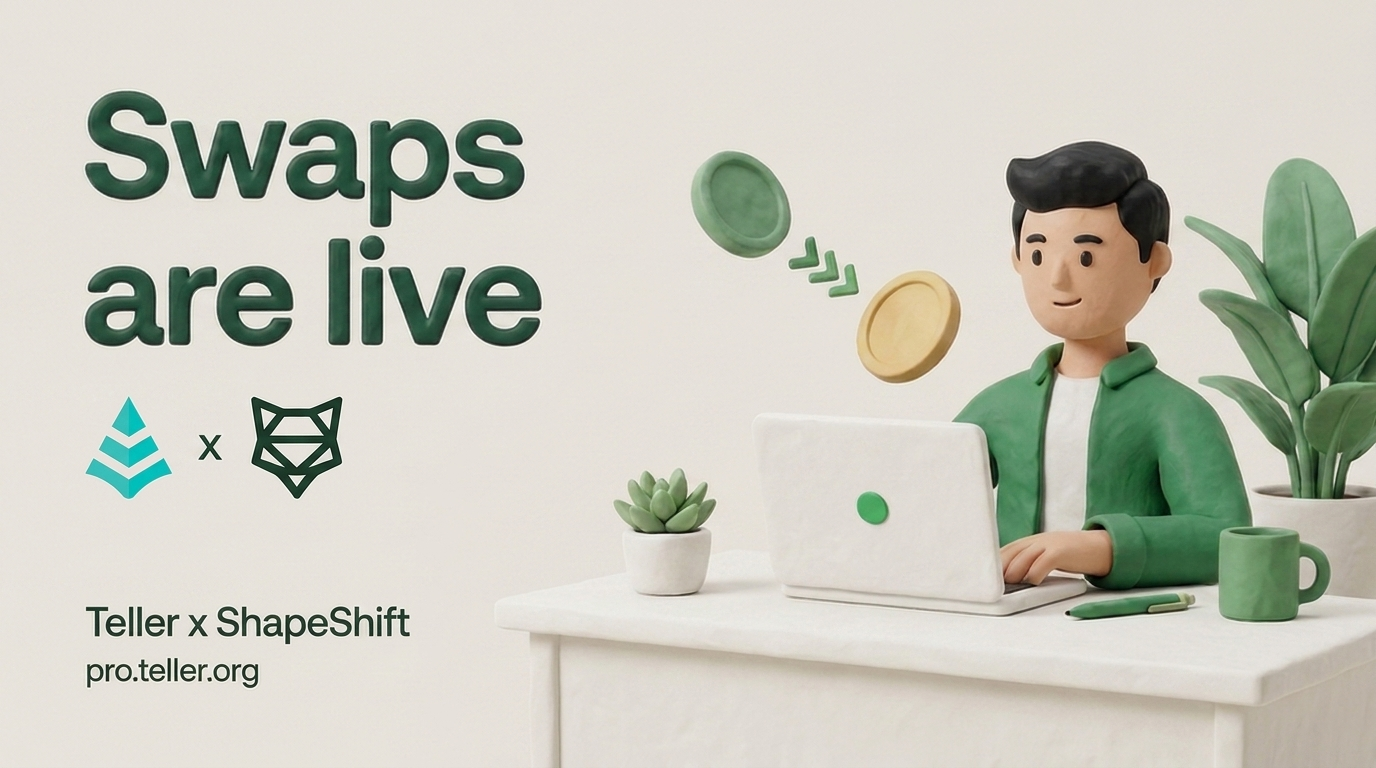
Teller now has in-app swaps across EVM chains, powered by ShapeShift's multi-chain aggregation API: every trade is quoted against a dozen-plus liquidity sources and executes non-custodially, so borrowing, lending, and swapping all happen in one app without keys ever leaving the user.
Teller users can now swap across EVM chains without leaving the app. The new swap flow at pro.teller.org runs on ShapeShift’s API. Here is what each side does, how the routing works under the hood, and why the combination matters.
Teller is built around one idea: the crypto you hold should do more than sit in a wallet. Borrow cash against assets like bitcoin and ether, borrow with no collateral if you pre-qualify, or lend stablecoins into pools that earn compounding yield. As of today, there is one more thing the app does: swap. And the way it does it is worth understanding, because the engine behind it is one of the longest-running pieces of infrastructure in crypto.
What Teller does
Teller gives people two distinct ways to borrow, and both are unusual in this industry.
Borrowing with no collateral. Answer a few questions about where you live, how much you need, and your income, and Teller runs a soft check to see whether you pre-qualify for a loan with nothing locked up. There is no hard credit pull at that stage. If it goes through, funds land directly in your bank account. Teller itself is a technology platform rather than the lender: loans are originated by third-party licensed lenders, and pre-qualifying is not the same as final approval. But the experience, checking your options in minutes without touching your crypto or your credit score, is something almost nothing else in the space offers.
Borrowing against assets you hold. The second path is asset-backed. Borrow against bitcoin, ether, and even tokenized stocks like Tesla without selling them. These loans are non-custodial and settle entirely on-chain, so exposure to the asset is preserved while cash is unlocked against it. Critically, Teller structures these loans to avoid the margin calls that make borrowing against volatile collateral so stressful everywhere else. There is no liquidation bot watching a price feed, waiting for a 10% drawdown to seize the position. As with any secured loan, collateral can still be liquidated if the loan is not repaid or rolled over on time, but the terms are known upfront and time-based rather than price-based.
Lending. On the other side of every loan is a lender. Deposit stablecoins or a supported token into a Teller pool and earn compounding yield with no impermanent loss and the ability to withdraw at any time. Teller runs these lending markets across assets on networks like Base and Ethereum, with pools and rates published openly.
The Teller Score. Tying the whole system together is an on-chain credit score built from your activity. Repay loans, use the platform, and better borrowing options unlock over time. It is a credit history that lives on-chain and belongs to you.
All of it runs in one app: track net worth, earn on idle stablecoins, borrow, and now swap, from a browser app that installs to the home screen on iOS and Android and opens as a Telegram or Farcaster mini app. And this is not an experiment. Teller has processed more than $80 million in loans and generated over $1.5 million in yield across a network of more than 50 lenders, with backing from Franklin Templeton, Toyota Ventures, Bessemer Venture Partners, Blockchain Capital, Upstart, and Framework.
The gap swaps fill
Nearly every action in Teller starts or ends in a specific token. Take out a loan and the proceeds arrive in one asset, but the plan might be to hold another. A lending pool pays out in its own asset. Collateral for the next loan might need to be on a different chain than where the funds currently sit.
Until now, closing that gap meant leaving Teller: open a DEX or a centralized exchange, figure out which one has liquidity for the pair, bridge manually if the tokens live on different chains, pay whatever spread that venue happens to charge, then come back. Every step in that round trip is friction, and several of them are places where users get worse prices than they should.
That entire round trip now collapses into one action inside the app at pro.teller.org.
How ShapeShift actually works
ShapeShift is one of the oldest names in crypto, operating since 2014 and now running as a decentralized, community-owned project. Its modern form is a non-custodial, multi-chain swap aggregator, and each of those words is doing real work.
Non-custodial means ShapeShift never holds funds. There is no deposit, no account, no identity check. Keys stay with the user from the first click to the settled trade. If ShapeShift disappeared mid-swap, the assets would still be under the user’s control, because they never left it. (New to holding your own keys? Our non-custodial USDC wallet guide covers what that means in practice.)
Multi-chain means coverage most single venues cannot match: more than 45 blockchains and over 30,000 assets, reachable through one interface.
Aggregator is the interesting part. ShapeShift does not run its own exchange or its own liquidity pools. Instead, for any given trade, it queries more than a dozen liquidity sources, DEXs, cross-chain bridges, and specialized routing protocols, and compares what each one would actually deliver. That comparison is smarter than just reading quoted prices. A route through one venue might show a better headline rate but carry higher gas costs, an extra bridge hop, or thinner liquidity that moves the price during execution. ShapeShift’s routing accounts for the route’s own costs and surfaces the path that delivers the most of the destination token to the user’s wallet. Best route means best net outcome, not first available fill.
For cross-chain swaps, this matters even more. Moving from a token on one chain to a different token on another chain is really two or three operations chained together: a swap, a bridge, sometimes another swap. Doing that manually means choosing a bridge, trusting it, paying its fees, and managing the intermediate steps yourself. ShapeShift’s routing composes the whole path into a single quote and a single execution.
ShapeShift offers this engine to other products in two forms. The first is the API: a team wires ShapeShift’s quoting, routing, and execution directly into its own app and inherits the full multi-chain backend without maintaining connections to every chain and liquidity source itself. The second is an embeddable widget, a ready-made swap interface that drops into any site and ships with theming support. Teller’s integration uses the API, wired straight into the app’s own swap flow, so the experience stays fully native to Teller.
What the integration does inside Teller
Users can swap across EVM chains directly in the app. For every swap, ShapeShift returns a route and a quote. When that route is the best one available, the trade executes through it. Teller users get aggregated pricing without needing to know or care which venue filled the trade.
Two networks get special treatment: on Monad and MegaETH, ShapeShift quotes are featured whenever a path exists. Liquidity on new networks is exactly where routing quality matters most, since fewer venues means bigger differences between the good route and the bad one, so putting ShapeShift’s coverage front and center on the newest EVM chains is a deliberate choice.
Why this combination is genuinely good
The lending-plus-swapping loop is more powerful than either piece alone. A few flows that now happen entirely inside one app:
Borrow, then position. Take a loan against bitcoin, receive stablecoins, and swap into the token you actually wanted exposure to, in one session, without the collateral ever moving.
Earn, then rotate. Withdraw yield from a lending pool and swap it into whatever comes next, a different pool’s asset, a long-term hold, or a stablecoin, without touching an external exchange. (Deciding which stablecoin to rotate into? See USDC vs USDT.)
Arrive from anywhere. Assets stranded on one EVM chain are no longer a barrier to using a Teller pool or loan on another. The swap flow handles the chain-crossing.
And the properties that make each product trustworthy are preserved through the whole loop. Teller’s asset-backed loans are non-custodial and on-chain; ShapeShift’s swaps are non-custodial and account-free. At no point in borrow, earn, swap, repeat does a user hand their keys to anyone. That is rarer than it should be, and it is the standard both teams build to.
Try it
The swap is live now at pro.teller.org. Borrow or lend as usual, and when a different token is needed, it is one swap away.
Frequently asked questions
ShapeShift's multi-chain aggregation API, wired directly into Teller's own swap flow. For each trade it queries more than a dozen liquidity sources, DEXs, cross-chain bridges, and specialized routing protocols, then executes through the route that delivers the most of the destination token to your wallet. ShapeShift's coverage spans more than 45 blockchains and over 30,000 assets.
Every route carries its own costs: gas, any bridge hops, and the liquidity depth of the venues involved. ShapeShift's routing accounts for those costs when it compares routes, so the quote you see reflects the net amount delivered to your wallet rather than a headline rate that ignores what the route costs to execute.
No. ShapeShift is non-custodial: there is no deposit, no account, and no identity check, and your keys stay with you from the first click to the settled trade. Teller's asset-backed loans are non-custodial too, so borrowing, earning, and swapping all happen without handing your keys to anyone.
See if you pre-qualify for a no-collateral loan
Answer a few quick questions to explore loan options from Lending Partners.
Check if you pre-qualify →